

Did you know that studies consistently show the majority of women are wearing the wrong bra size? Whether your bra is riding up at the back, digging into your shoulders, or simply not giving you the support you deserve, the chances are the sizing is off.
The good news is that measuring your bra size at home is straightforward, and all you need is a soft tape measure and a few minutes. This guide walks you through the process step by step using Australian sizing, plus includes a handy conversion chart so you can shop confidently from any brand, wherever they are based.
What You Need Before You Start
Before you grab the tape measure, a couple of things will make your measurements more accurate.
- A soft fabric tape measure (not a rigid ruler or metal tape).
- A well-fitting, non-padded bra. Avoid thick padding as it can add to your measurements and throw off your result. A simple t-shirt bra or a bralette works well.
- A mirror or a friend to help you measure around your back.
- A pen and paper to jot down your numbers.
Femmeline Tip: Measure yourself standing up straight, not slouching. Even small changes in posture can affect your band and bust measurements.
Step 1: How to Measure Your Band Size
Your band size is the number part of your bra size, for example the 14 in 14D.
How to do it
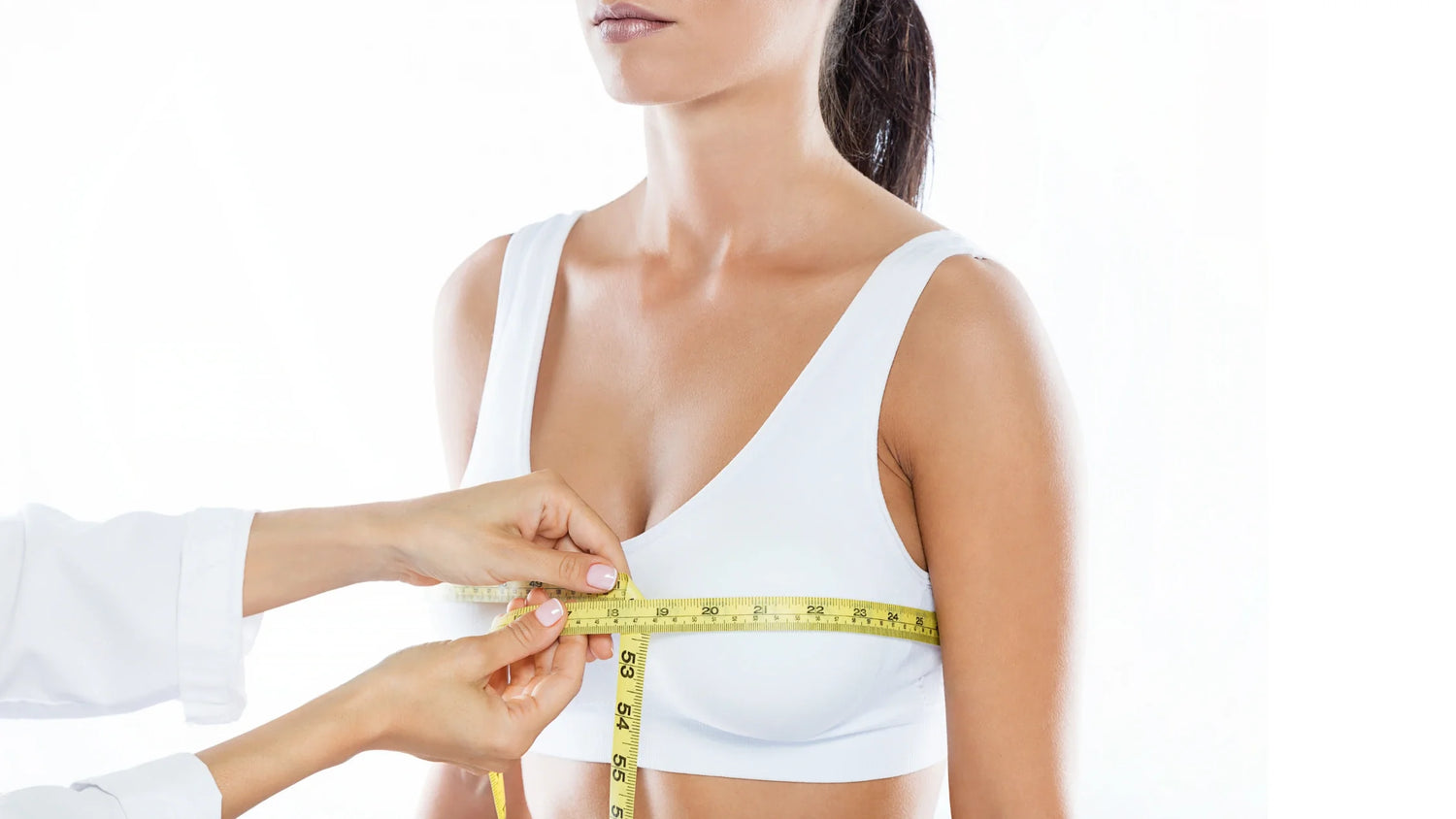
Wrap the tape measure firmly around your torso, directly underneath your bust. The tape should sit flat and parallel to the ground, not slanting up at the back. It should be snug but not so tight that it digs in. You should be able to fit two fingers underneath comfortably.
Take note of this measurement in centimetres. This is your underbust measurement.
Converting to the Australian band size
Australian band sizes are based on your underbust measurement in centimetres, but they do not match directly. Use the guide below to find your band size.
- 63 to 67 cm: Size 10
- 68 to 72 cm: Size 12
- 73 to 77 cm: Size 14
- 78 to 82 cm: Size 16
- 83 to 87 cm: Size 18
- 88 to 92 cm: Size 20
- 93 to 97 cm: Size 22
Femmeline Tip: If your measurement falls between two sizes, try both and choose whichever is more comfortable. Most women find it helpful to try the smaller size first, as bra bands stretch with wear.
Step 2: How to Measure Your Cup Size
Your cup size is the letter part of your bra size, for example, the D in 14D. It represents the difference between your bust measurement and your band size, not a fixed volume.
How to do it
Keeping the tape measure level all the way around your body, measure across the fullest part of your bust. This is usually across your nipples. Do not pull the tape tight. It should sit gently against your skin with no gaps and no squeezing.
Write down this measurement in centimetres. This is your overbust measurement.
Calculating your cup size
Subtract your underbust measurement from your overbust measurement. The difference between the two numbers tells you your cup size. Use the chart below.
|
Difference (cm) |
AU / UK Cup |
US Cup |
EU Cup |
|
Less than 1 |
AA |
AA |
AA |
|
1 |
A |
A |
A |
|
2 |
B |
B |
B |
|
3 |
C |
C |
C |
|
4 |
D |
D |
D |
|
5 |
DD |
E |
E |
|
6 |
E |
F |
F |
|
7 |
F |
G |
G |
|
8 |
FF |
H |
H |
|
9 |
G |
I |
I |
Example: If your underbust measures 76 cm (size 14) and your overbust measures 83 cm, the difference is 7 cm, which corresponds to an F cup. Your bra size would be 14F.
Femmeline Tip: Cup size is always relative to band size. An F cup on a size 12 is quite different in volume from an F cup on a size 18. This is why getting the band size right first is so important.
Australian Bra Size Conversion Chart
Shopping from an international brand? Australian bra sizing follows the same system as UK sizing, so if a bra is labelled in UK sizes, you can wear your Australian size directly. US and European sizes are different, so use the charts below to convert.
Band Size Conversion
|
AU / UK |
US |
EU |
IT / FR |
|
8 |
28 |
60 |
60 |
|
10 |
30 |
65 |
65 |
|
12 |
32 |
70 |
70 |
|
14 |
34 |
75 |
75 |
|
16 |
36 |
80 |
80 |
|
18 |
38 |
85 |
85 |
|
20 |
40 |
90 |
90 |
|
22 |
42 |
95 |
95 |
Cup Size Conversion
Cup sizes align between AU and UK. The main differences are in US and European sizing.
|
AU / UK |
US |
EU |
Note |
|
A |
A |
A |
|
|
B |
B |
B |
|
|
C |
C |
C |
|
|
D |
D |
D |
|
|
DD |
E |
E |
AU DD = US E |
|
E |
F |
F |
|
|
F |
G |
G |
|
|
FF |
H |
H |
AU FF = US H |
|
G |
I |
I |
|
|
GG |
J |
J |
AU GG = US J |
|
H |
K |
K |
|
Femmeline Tip: When shopping US brands, remember that AU/UK cup sizes jump from D to DD, while US cups go D to E. Always check the brand's own size guide if you are unsure.
Common Bra Fit Problems and How to Fix Them
Measurements give you a great starting point, but fit is ultimately something you feel. Here are the most common fit issues and what they usually mean.
- The band rides up at the back. This usually means the band is too loose. Try going down a band size. If the band feels too tight at the same time, go up a cup size to compensate (this is called sister sizing).
- The underwire sits on breast tissue instead of the chest wall. Your cup size is likely too small. Try going up one or two cup sizes while keeping the same band.
- Straps dig in or fall off your shoulders. Straps that dig in suggest the band is not doing enough work, and the cup may be too small. Straps that fall off usually mean the bra is too wide in the back.
- There is a gap between the cup and your bust. The cup size is too large. Try going down a cup size.
- You have spillage over the top or sides of the cup. Your cup size is too small. Go up one or two cup sizes.
- The centre front does not sit flat against your chest. This is usually a sign that the cup is too small and the underwire is being pushed away from your body.
A useful trick to remember is sister sizing. If a bra feels right in the cup but wrong in the band, you can adjust both together. Going up a band size and down a cup size keeps the cup volume roughly the same. Going down a band size and up a cup size does the same. For example, a 14D is a sister size to a 12DD and a 16C.
When to Get a Professional Bra Fitting
Measuring at home is a great first step, but there are times when a professional fitting really makes a difference. Consider booking an expert fitting if any of the following apply to you.
- You have never had a professional bra fitting before.
- Your body has changed significantly, including weight changes, pregnancy, breastfeeding, or surgery.
- You are buying your first post-mastectomy bra or breast prosthesis.
- You have a larger cup size (DD and above) and struggle to find bras that feel truly supportive.
- You are buying a bra for a special occasion, such as a strapless style or a sports bra, and want to be sure of the fit.
- You have ongoing discomfort, back pain, or shoulder pain that you suspect may be related to your bra.
A trained fitter can see things that self-measuring cannot always capture, including how the bra sits on your body in motion, whether the underwire placement is correct for your shape, and how different brands and styles compare on you specifically.
Book Your Bra Fitting at Femmeline
At Femmeline, we have been fitting women of all shapes, sizes, and needs for over 67 years. Our team of experienced, trained corsetieres and fitters offer private, one-on-one fittings at our Croydon store in Melbourne, where nothing is rushed and every detail matters.
Whether you are looking for your perfect everyday bra, a post-mastectomy fitting, a sports bra, or simply want to finally find out your true size, we are here to help. We also stock an extensive range of bras and lingerie online, with delivery across Australia.
Visit us at 14 Hewish Road, Croydon VIC 3136 or shop online at femmeline.com.au
Frequently Asked Questions
Got more questions about bra sizing? Here are the answers to the questions we hear most often at Femmeline.
Q: What is the most common bra size in Australia?
A: The most commonly purchased bra size in Australia is around 14B or 14C, but research and in-store fitting experience consistently shows that a large proportion of women are actually wearing a larger cup size than they think. This is largely because cup sizing is still widely misunderstood. Getting professionally fitted often reveals that women need a smaller band and a larger cup than what they have been buying.
Q: How often should I measure my bra size?
A: We recommend re-measuring your bra size at least once a year, and any time your body changes. Weight gain or loss, pregnancy, breastfeeding, hormonal changes, and surgery can all affect your measurements. Even without obvious physical changes, your bra fit can shift as your current bras stretch with wear. Many women find that a fitting every 12 months keeps their wardrobe feeling fresh and comfortable.
Q: Why does my bra size vary between brands?
A: Bra sizing is not standardised across manufacturers. Two bras labelled the same size can fit very differently depending on the brand, the style, the fabric, and the cut. Some brands run small in the cup, others run large in the band. This is why your measurements are a starting point rather than a guarantee, and why trying on multiple styles is so important. If you are buying online, always check the brand's individual size guide before ordering.
Q: Is Australian bra sizing the same as UK sizing?
A: Yes. Australian bra sizing follows the same system as UK sizing exactly. If a bra is labelled in UK sizes, you can wear your Australian size without any conversion. The only time you need to convert is when shopping US or European brands, as both use different band and cup size scales. Refer to the conversion charts above for guidance.
Q: What is sister sizing in bras?
A: Sister sizing is a technique used to adjust your bra fit when the band feels wrong but the cup volume is right. Because cup size is relative to band size, you can move one size up or down in the band while adjusting the cup to match, and the overall cup volume stays roughly the same. For example, a 14D, a 12DD, and a 16C are all sister sizes of each other. If your band feels too tight but the cup fits well, try going up to the next band size and down one cup size. If the band is too loose, try the reverse.
Q: Can I measure my bra size without a tape measure?
A: A soft fabric tape measure is by far the most accurate tool for measuring your bra size at home. In a pinch, you could use a length of string or ribbon, mark where it meets, and then measure that length against a ruler. However, we do not recommend this as a regular method as it is much harder to get a consistent, snug reading. A basic fabric tape measure is inexpensive and widely available from craft stores, pharmacies, and variety stores across Australia.
Q: How do I measure my bra size if I am pregnant or breastfeeding?
A: Measuring during pregnancy and breastfeeding follows the same steps, but your size can change frequently throughout both stages. Your underbust measurement may increase as your ribcage expands, and your cup size will change as your breasts grow. We recommend measuring every few weeks during the second and third trimesters, and again once milk comes in if you are breastfeeding. A maternity or nursing bra fitter can help you find styles that accommodate these changes comfortably. Femmeline stocks a range of maternity and nursing bras and can assist with specialist fittings.
Q: What should I do if I am between sizes?
A: It is very common to fall between sizes. If your underbust measurement sits right on the boundary between two band sizes, try both and choose the one that feels most comfortable with the bra on the loosest hook. This gives you room to tighten the band as it stretches with wear. For cup sizes, if you are between letters, try both and assess which gives you a smooth silhouette with no spillage and no gaping.
Q: Does cup size change if I go up or down a band size?
A: Yes, and this is one of the most important things to understand about bra sizing. Cup size is always proportional to band size, not a fixed measurement. If you go up a band size, you need to go down a cup size to keep the same cup volume. If you go down a band size, you need to go up a cup size. This is sister sizing in practice. For example, if you normally wear a 16D but want a tighter band, try a 14DD rather than a 14D.
Q: Where can I get a professional bra fitting in Melbourne?
A: Femmeline offers professional bra fittings at our store in Croydon, Melbourne. Our team of experienced corsetieres and trained fitters provide private, one-on-one appointments where you can try a wide range of styles and find your true size. We specialise in everyday bras, post-mastectomy bras, sports bras, maternity and nursing bras, and plus size fittings. Visit us at 14 Hewish Road, Croydon VIC 3136, or contact us through femmeline.com.au to find out more.
Related searches: how to measure bra size australia | bra size guide australia | australian bra sizing | bra size calculator australia | bra size conversion chart | how to measure cup size | bra fitting melbourne | bra fitting croydon | bra size uk to australia | bra size us to australia




Leave a comment
This site is protected by hCaptcha and the hCaptcha Privacy Policy and Terms of Service apply.